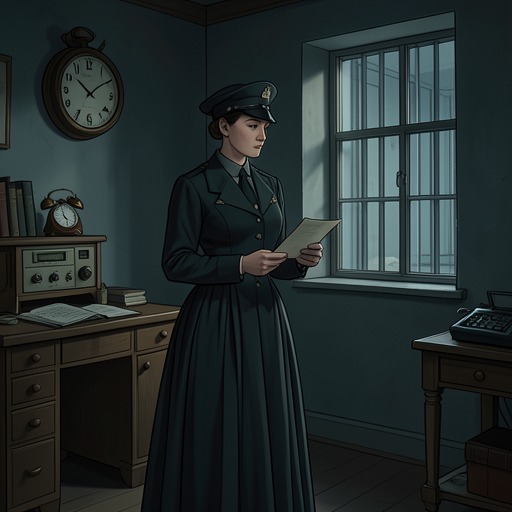
William’s arrest and Jenny’s escape
American WomanWilliam’s arrest and Jenny’s escape is the rupture that turns a shared political life into a solitary fugitive existence. The arrest catches them in the ordinary interval between one day and the next: William is taken at their rented workshop, while Jenny is at home preparing their dinner. She escapes, but survival does not feel like a clean release. It leaves her separated from the person with whom she had done everything, and waiting for him becomes the purpose around which her hidden life is organized.
The Arrest and the Unplanned Separation
Jenny and William had made plans for what they would do if both were arrested. They had never discussed what should happen if only one of them were caught. Their actions had always been undertaken assiduously together; moving in tandem was part of the power of their partnership. William’s arrest therefore exposes a gap not in their commitment but in their preparation: they had imagined a shared fate, not the sudden asymmetry of one captive and one fugitive.
The capture itself arrives through accident rather than a planned confrontation. On his way home, William intends to stop at the garage they rent to collect a tool. Jenny is at home making salad for dinner, with lasagna in the oven. As part of her constant vigilance, she listens to the police band, but her attention is also fixed on the stairway and the sound of William’s expected arrival. Instead, FBI agents arrest him at the workshop. Jenny runs through the apartment, gathering belongings into two grocery bags, and leaves.
The separation acquires the force of a death in Jenny’s understanding of it. William had once described a true marriage as one in which the fear of outliving the other made the fear of one’s own death seem minor. His arrest brings that idea into brutal reality for her: she wants to die too, but knows she must continue living and wait for him. When he later suggests that she turn herself in, she experiences the suggestion as a possible severing of their bond, even while recognizing that this is not what he intended.
Flight and the Work of Staying Hidden
Jenny’s escape is not simply a departure from the apartment; it begins a prolonged effort to remain unremarkable in places where she feels conspicuous. In Rhinebeck she makes herself familiar to local people, introducing herself to the hardware-store owner, the train conductor, and the librarian. She understands this friendliness as an attempt to get ahead of suspicion, especially because she is the town’s lone Asian face. Yet the effort cannot guarantee safety. After one shopping trip, she hears the hardware-store proprietor identify her to another man as she leaves; the proprietor, once friendly, has just rung her up in silence.
The anniversary of William’s arrest passes without Jenny noticing it until several days later. The date also marks her flight from the apartment with her two bags and Rob Frazer’s drive with her through the darkness on I-5 to the Los Angeles airport. Discovering that she has missed the anniversary unsettles her as if she had exposed herself through some rash, involuntary act. The lapse reveals the strain of a life built around constant self-monitoring: even a private failure to keep track of time can feel like a dangerous loss of control.
Her isolation also makes the practical case for having a companion. Jenny longs for someone who could offer another perspective, catch errors produced by paranoia or overconfidence, and keep her from confiding in someone unsafe. She is aware of both extremes in herself, and of how quickly a lapse in judgment might become reckless. But the desire for companionship is not merely a security measure. She is lonely, and the people she meets in town cannot replace the absent partner with whom she once shared every action.
Letters, Signals, and the Prospect of Surrender
Contact with William continues through Dana, who serves as an intermediary. Jenny’s letters go to Dana in Boulder, who recopies them and forwards them to William; his replies travel back through the same relay. Jenny hears that Dana thinks she is doing well, although the indirect route means she cannot simply reach out to William whenever she wants. Their correspondence preserves a connection, but its very structure records the distance and precautions imposed by the arrest.
William and Dana also correspond independently of Jenny. Dana sends Jenny the name and number of a lawyer, in a note whose language Jenny recognizes as William’s. The proposal unsettles her because the two have been discussing her fate without her, and because it raises the possibility of surrender. She and William had prepared for the possibility that both might be arrested, but not for a future in which she alone must decide whether to give herself up. She replies that she will make contact, then does not call. The lawyer’s number, written on a slip of paper, stays hidden under the insole of one of her shoes, so that she steps on it throughout the day without yet acting on it.
In winter Jenny goes down to the river to watch the train, the same train on which she arrived at Wildmoor. At first, its route beside the property had seemed to preserve the possibility that she would someday continue her journey. Now she knows it goes to Canada. She imagines the chance of saving enough money and crossing the border, but understands that the imagined escape has no practical foundation: she has neither the necessary documents nor the money, and no Canadian friends. The train becomes a visible alternative to surrender that remains inaccessible in fact.
A separate, highly compressed ritual of communication shows how fugitive contact has narrowed into signals. At a phone booth beside a boarded-up diner on the outskirts of Liberty, Jenny sorts dimes from a battered bag of change. She and Dana have established a procedure: Jenny calls, asks whether Dana has received something, and hangs up if the answer is no. When Dana says yes, Jenny tells her to wear dishwashing gloves to remove the package and not to touch a second envelope inside. The exchange is brief, guarded, and dependent on trust; ordinary calls have become a system for transmitting material without explaining it over the line.
The Long Pursuit and the Meaning of the Flight
The investigation that follows makes the fugitive’s physical traces part of the story. At an abandoned house, investigators find a partial fingerprint matching a man’s left index finger and infer that he had been there at least six months earlier. The house has been empty since at least September. A search of the couch, cupboards, plates, utensils, and other likely hiding places yields little, until agents turn over a mattress and find tape adhering to its underside with a plug of newspaper attached. The residue of past presence is both materially slight and consequential: a partial print can put investigators on a trail, even when that trail is already cold.
The house’s near-absence of ordinary debris marks a change in the fugitives’ methods. Earlier, they had left notebooks, dirty clothes, spoiled food, cigarette butts, graffiti, and a bathtub filled with contaminated water and objects they considered evidence. After thirteen months, the conspicuous mess has given way to deliberate erasure and apprehension. Their effort to protect themselves has become visible precisely through what is missing: the house is too clean to be accidental.
Later, the FBI has discovered a farmhouse where Pauline had been hiding and has linked her to someone named Jenny Shimada. Rob Frazer recounts that agents ambushed him when he went to the farmhouse; they could not hold him, but questioned him about what they knew. The investigation thus reaches beyond Jenny’s original escape and into the network of places and associations surrounding the fugitives. Across these episodes, flight is neither a single act nor a solved problem. It is a continuing discipline of concealment, mediated contact, and deferred decisions, while Jenny’s attachment to William keeps the possibility of reunion alive alongside the possibility that survival may require surrender.